There are no items in your cart
Add More
Add More
| Item Details | Price | ||
|---|---|---|---|

Studies show that within the first few seconds, people form impressions about the presenter’s competence. Which means, within half a minute your audience will decide whether you’re adept on the subject of the presentation based on your body language and vocal attributes. What you say and how you say it are equally important. The good news is that there is a plethora of evidence explaining how you can present the appearance of confidence and competence — even if it’s an unplanned presentation.
Let’s look at what it takes to make an impressive presentation, or in other words,
the 3 attributes of an effective presentation.
As the diagram illustrates, according to experts, there are three important attributes of an effective presentation.
1. Content
2. Presenter
3. Voice Delivery
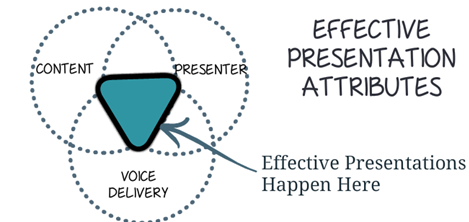
When it comes to content, the structure of your content can be organized as Introduction , body and a conclusion. Sometimes applying the presentation’s content in other ways to suit your delivery techniques may result in double effect. Visual aids such as PowerPoint, prop or any real objects may help you to deliver the message across your audience and can aid in organizing the content too.
The presenters ability to use the appropriate verbal and non-verbal skills while delivering the presentation will help you to attract the attention of the audience with ease. Making eye contact during conversation is an important social skill. It can affect how you are perceived by others both in personal and professional relationships. A lot of sources report that eyes play a key role in human social encounters. Eyes are typically the first features that are scanned for information when humans observe.
There’s a simple way to get better at this, but it takes a little work: Record yourself practicing your presentation in front of a small audience. Watch the recording, noting all of the times you look at your slides instead of at your audience. Practice and record again. Every time you do, try to spend less time talking to the slides and more time making eye contact with your listeners. Keep an open posture. Open posture means that there’s no barrier between you and the audience. This includes your arms. An uncomfortable speaker might unconsciously cross their arms, forming a defensive pose without being aware that they’re doing it. Confident speakers, by contrast, keep their arms uncrossed with their palms turned up. But your hands and arms are just one barrier.
There are others to eliminate. A lectern is a barrier. Stand away from it. A laptop between you and your listener is a barrier. Set it to the side. If you keep your hands in your pockets, take them out.
An open posture takes up more space and makes you feel more confident. If you feel confident, you’ll look confident. Use gestures. Confident speakers use gestures to reinforce their key points.
Experts say that entrepreneurs pitching investors are more likely to get their point across when using a combination of figurative language (stories, metaphors) and gestures to emphasize their message. Find areas of your presentation where gestures will come across as natural and use them to highlight key points or emphasize a concept. If you’re listing several items, use your fingers to count them off. If you’re talking about something wide or expansive, stretch your arms and hands apart. One analysis of popular TED speakers, like Brené Brown and Tony Robbins, found that they tend to bring their hands to their hearts when sharing personal stories. Your gestures will reflect your feeling towards the topic you’re discussing and invite the audience to engage with you on a deeper, emotional level. These kinds of verbal and non-verbal skills are the impressive elements of an effective presentation. The power of pause, silence and right questions at right times are equally valuable as the power of your words.
Hopefully, young leaders will find this useful to implement these ideas into your next presentation to influence the people to bring changes into your working environment.

Shiyama Marikkar
Shiyama Hafeez Marikkar
 Launch your Graphy